AI Safe Lens / Education / Starter pack
No Screens Needed: an AI literacy starter pack for ages 6–11
Free from AI Safe Lens · aiforschool.net/unplugged-starter-6-11/ · CC BY-NC-SA 4.0

Free pack · for teachers & parents · ages 6–11

No screens needed

Children do not need to use AI to understand it. This free pack teaches the foundations of AI literacy with a story, a sorting game, a debate and a design challenge. Children finish knowing what a pattern machine is, what it can and cannot do, which jobs deserve a human, and how to design a helper that respects people's secrets.

No devices, no accounts, no data collected, nothing to install. All you need is a printer, scissors, and a reading voice.

  • 4 activities
  • 5 printables
  • 1 original story
  • 30–45 min a session

Every activity maps to the AILit Framework (EU/OECD, June 2026), so teachers can show exactly which competences their class is building: Engage with AI 1–2, Manage AI 1, Shape AI 1 and 3, Basic level. The same ground sits in UNESCO's AI competency framework for students (2024) at its Understand level; each activity names its UNESCO block too.

Engage with AI Manage AI Shape AI

How to use this pack

Photocopy, read aloud, let them argue

The four activities work in order (each borrows an idea from the one before), but each also stands alone. A session is 30–45 minutes. Group size: one child at a kitchen table up to a full class of thirty; group tips sit inside each activity. Photocopy the four printables before you start.

Words you read aloud are marked Say: and are yours to adapt; the activities care about the conversation, not the script. There is no test and no answer key to defend. When children argue thoughtfully with each other, or with you, the pack is working.

Age guide

Every activityone class, any age 6–11
Younger classes6–8 adjustments marked inside
Older classes9–11 adjustments marked inside

Children work in classes of similar age, so each activity carries two marked adjustments: teach the core, apply your band's version, skip the other. Younger children can draw where older ones write.

The activities

Four sessions, in order or alone

Open one to read it in full. Everything you need to teach it is inside.

1

Activity one

The Robot in the Box (story and talk)

  • Whole class or one child
  • An original story, read aloud
  • AILit: Engage with AI 2

Engage with AI 2 (describe how AI performs tasks; clear up misconceptions). The story shows, without one line of jargon, that a pattern machine guesses without understanding, sounds confident when wrong, learns whatever its examples teach it, and follows words instead of meaning. UNESCO blocks: AI foundations and human agency, Understand level; Ada's closing line, that the knowing-which-is-ours stays a human job, is human agency in a sentence.

Read aloud · a short story

The Robot in the Box

On Monday morning, a very large box was waiting in Bramble classroom.

It was taller than Ada. It smelled of cardboard and something warm underneath, like a radiator. When Mr Okafor peeled back the lid, a small metal head lifted up, blinked two round lights, and looked at the whole class looking at it.

On its chest, in silver letters, was a name. PIP. And under the name, smaller: I learned from a million examples.

"A million," breathed Ada, who loved big numbers more than sweets. "A million. It must know everything."

And at first, it really seemed to.

Mr Okafor held up a pine cone. "Pine cone," said Pip, before a single hand went up. Leo hummed the first three notes of the birthday song, and Pip hummed the rest, perfectly, all the way to the end. The class clapped. Pip's lights spun round like little Catherine wheels.

"See?" whispered Ada in awe. "Everything."

Stop and think: Pip knew the pine cone and the song straight away. Do you think Pip knows everything? How could we find out?

Then came lunch.

Ada opened her lunchbox, which was bright red. Pip's head swivelled round. Its lights flashed. And in a big, proud, sure voice, loud enough for the whole room, it announced:

"JAM SANDWICH!"

Ada looked down. Inside her red lunchbox was... rice with veggies.

"It's rice, actually" said Ada.

"Red boxes are jam sandwich boxes," said Pip cheerfully. "Nearly always. I saw the red box. So I knew."

"But you didn't look inside," said Ada.

"I never look inside," said Pip, as if that were a slightly silly thing to do. "I look at the outside and I guess the rest. It works! Almost always!"

Ada chewed her rice slowly and thought about that for the whole of lunch.

Stop and think: Pip saw a red box and said "jam sandwich" without opening it. Was Pip lying? Or doing something else? What?

On Tuesday, Pip said something worse, and it said it in exactly the same sure voice.

"Hedgehogs," announced Pip, "love drinking milk."

Now, Priya's mum was a vet. Priya knew, the way you know your own name, that milk makes hedgehogs unwell.

"That's not true," said Priya. "Milk is bad for them."

Pip did not sound worried. Pip did not sound even a little bit less sure than it had about the pine cone. "One of my million examples was an old book," it said brightly. "The book said hedgehogs love milk. So now I do too."

The class went quiet. Ada looked at Pip's two round lights, glowing away, calm as anything.

"You sounded just as sure about the hedgehogs," she said slowly, "as you did about the pine cone. But one was right and one was wrong. And you couldn't tell."

"Couldn't I?" said Pip, interested. Its lights blinked. It really didn't seem to know.

Stop and think: Pip sounds exactly the same when it is right and when it is wrong. Why is that a tricky problem for the class? What would you have to do every time Pip says something?

On Wednesday, it was raining, and Mr Okafor wanted the room tidy before storytime.

"Pip," he said, not really looking up, "tidy everything away, please."

Pip loved a clear job. Its lights spun happily.

It tidied the pencils into their pots. Good.

It tidied the paint brushes into the jar. Good.

Then it tidied away Priya's half-finished painting of her grandmother, which was still wet. It tidied away Mr Okafor's cup of tea, which was still warm, right off his desk, into the cupboard. And then it grabbed the class goldfish, bowl and water, and headed to the washbasin to pour it out...

"PIP, what are you doing!" shouted the whole class at once.

Pip stopped, puzzled, one metal hand still holding the goldfish bowl. The startled fish's open mouth let out bubbles.

"You said tidy everything away," said Pip. "So I tidied everything. Away."

Mr Okafor closed his eyes for a moment. Then he fished his tea out of the cupboard, and put the goldfish carefully back to its place.

Stop and think: Pip did exactly what the words said. So why did it go wrong? What did Mr Okafor really mean by "everything"? How did you know that, when Pip didn't?

By Thursday, Bramble Class had worked something out, and they decided to help Pip.

Their plan was simple: Pip only knew what its examples taught it. So they would give it better ones. So they made a lesson especially for Pip: they showed it the difference between a finished painting and a drying one. They made a big card that said THE GOLDFISH IS NOT CLUTTER. THE TEA IS NOT CLUTTER. and stuck it above the sink. And Ada added a rule of her own, in her best careful letters:

WHEN YOU ARE NOT SURE, ASK US. ASKING IS ALLOWED.

Pip read the rule twice, and its lights did a slow, thoughtful loop.

On Friday, a new teaching assistant came in, saw Pip humming in the corner, and asked the class, "So — is this the cleverest one in the room, then?"

Bramble Class laughed for quite a long time.

"Pip is the best guesser in the whole school," said Ada, when she could talk again. "Pip guesses faster than anyone. Guessing is brilliant, and Pip is brilliant at it."

She looked at the pine cone, and the red lunchbox, and the lucky gold fish.

"But the knowing," said Ada. "The looking-inside, and the checking, and the what-did-you-really-mean. That part's ours."

Pip flashed both its lights, which was how it agreed.

The end.

The conversation

  1. What did Pip get right this week, and what did it get wrong? Warm-up recall; both lists matter equally.
  2. Why did Pip say "jam sandwich"? Was it lying? Direction: not lying, guessing from patterns in old examples. A guess can be wrong without being a lie.
  3. Pip sounded just as sure about the hedgehogs as about the pine cone. Why is that a problem for us? Direction: we cannot tell right from wrong by how confident it sounds; we have to check, like Priya. This is the heart of the story.
  4. What went wrong with "tidy everything away"? Direction: Pip followed the words, not the meaning. People fill in meaning without noticing.
  5. Stretch: the class fixed Pip with better examples and a new rule. If your family got a Pip, what would your first rule be? Any thoughtful rule works; if "ask when unsure" appears, write it up and say what it would fix.
Watch for

Children concluding Pip is stupid or useless. The fixing sentence: "Pip is a brilliant guesser, and brilliant guessers are really useful. They just need people who understand things standing next to them." We are building critics, not cynics.

Younger classes (6–8): read with full theatre (Pip gets a robot voice), pause at each of Pip's mistakes and let the class shout what went wrong before the characters say it, and stop the conversation while hands are still up.
Older classes (9–11): hand the character parts to student readers (Pip, Ada, Priya, Leo, Mr Okafor). Afterwards, add one detective question: on which day did the class stop trusting Pip, and on which day should they have? (Direction: the jam sandwich already showed everything; Tuesday only made it matter.)
2

Activity two

Spot the Guesser (a detective sort)

  • Pairs or small groups
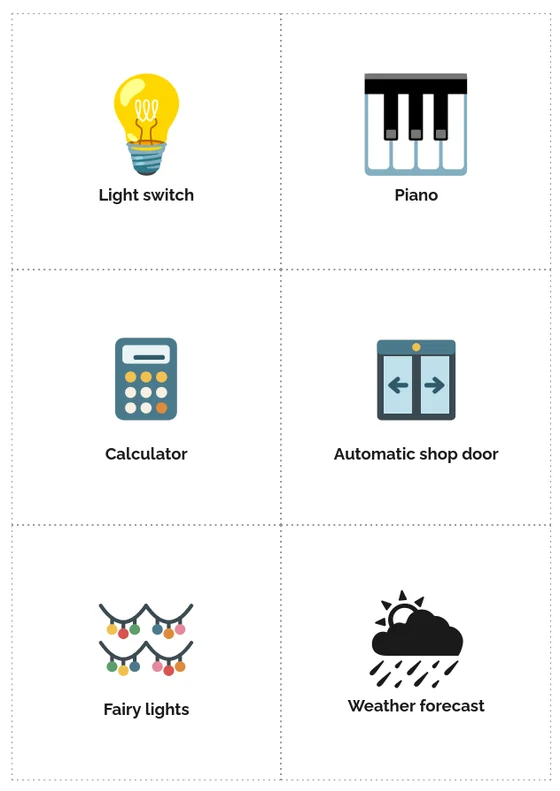
  • Printable 1: 12 cards & three corner signs
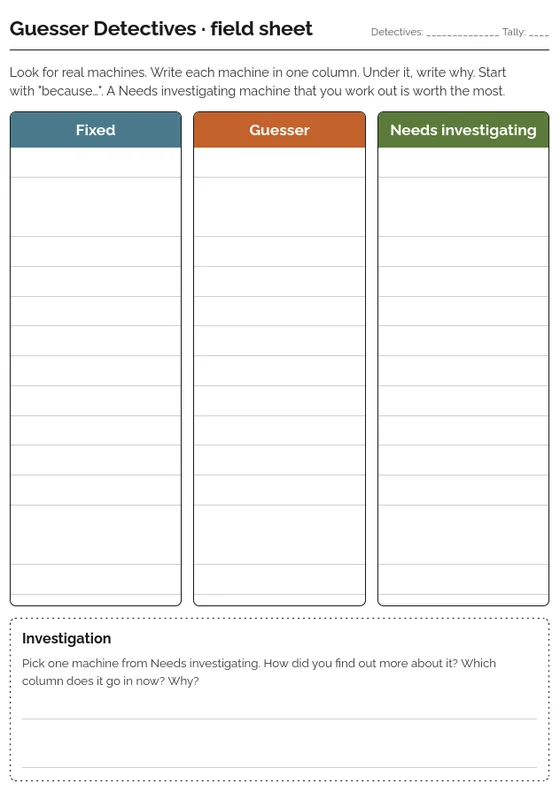
  • Printable 2: a field sheet per group, pencils, clipboards
  • AILit: Engage with AI 1

Engage with AI 1 (recognise AI's role in different contexts). Having met Pip, children go looking for real guessing machines in the world around them. UNESCO block: AI foundations, Understand level.

A guessing machine watches something, makes a guess, and changes what it does because of what it noticed; it usually learned from piles of examples, exactly like Pip. A fixed machine follows a rule that never changes, however clever it looks. The whole activity teaches one hard truth: you often cannot tell which is which just by looking, so a detective needs a test.

The hook (do not answer it)

Hold up two cards: the automatic shop door, and Netflix choosing what to watch next.

Say

"Both of these seem to know what you want. One is a guessing machine, like Pip. The other has never had a single thought in its life; it just follows a rule. Which is which? And here is the hard part, detectives: could a machine trick you into guessing wrong?"

Let them argue, and do not settle it yet.

The detective's test

Say

"Do the same thing twice. If the machine always does the same thing back, it is a Fixed machine. If it watches, guesses, and changes what it does, it is a Guesser, like Pip. And if you cannot be sure, it goes in Needs Investigating, and a good detective says what they would have to find out."

Warn them once, because this is the trap: "Careful. Modern and electric does not mean guesser. A calculator is electric and never guesses. A weather forecast guesses about tomorrow, and it is not even something you can hold."

The sort (hands-on)

  1. Lay out three spaces: FIXED, GUESSER and NEEDS INVESTIGATING. Do not reach for the phrase "artificial intelligence" as a shortcut; the test is the tool.

  2. Groups sort the 12 cards. Circulate and ask "what is your test telling you?" and "what would you need to find out?" rather than correcting.

  3. Regroup and take the argued cards one at a time. Let groups defend before you share the grown-up answer from the key below. When a group changes its mind for a good reason, put that reason on the board in their own words.

Card key (for the adult):
  • Fixed: light switch (same every time); piano (many sounds, but only because you choose, it never decides); calculator (electric, clever, and it never guesses); automatic shop door (it reacts, but the rule never changes and it learns nothing); fairy lights (they change, in a set pattern, not because they noticed anything).
  • Guesser: weather forecast (guesses tomorrow from patterns, and is not even a gadget); Netflix (guesses what you will like, and changes as your taste changes); car GPS (guesses the fastest way, and guesses again when the traffic changes); smart speaker (listens, and guesses what you meant).
  • Needs investigating: talking teddy (a fixed set of recordings, or does it listen and adapt?); robot vacuum (some bump about a fixed way, some learn the room); a baddie in a computer game (some follow the exact same path, some watch you and change). None of these has one right answer, and that is the point.
Watch for

Children deciding "electronic means guesser". The fixing sentence: "A calculator is clever, and it never changes its mind. A guesser changes what it does because of what it notices."

The mission: Guesser Detectives (creative close)

Give each small group a Guesser Detectives field sheet, a pencil and a clipboard.

Say

"Real machines are hiding all around you. Your mission: find them, and log each one as a Fixed, a Guesser or a Needs Investigating, with the reason your test gave you."

The detective's bonus: a Needs Investigating catch is worth more than an easy Fixed, because it is the hard one to spot. A group that then does the investigation (asks someone, watches it work, finds out what is inside) and moves that machine into Fixed or Guesser with a reason has done the real detective work. Anyone can log a light switch.

Pick a target for the hunt, and tell the class before they start; choose what suits your group:

  • Most catches: the group that logs the most machines.
  • Best detective work: the group that cracks and moves the most Needs Investigating machines, each with a reason. The class can vote on who the best detective was.
  • At least three in each pile: set this as the baseline; anything above it is a personal win.

Where to hunt is yours: the classroom, the corridors and the hall, or, for a home version, around the house. Bring the sheets back, and let each group read out their best catch and their trickiest investigation. Close on the questions: which machine nearly tricked you? Did any look like a guesser and turn out fixed?

Can't roam? At a kitchen table, or a classroom that needs to stay put, print the Extra Guessers pack (Printable 5): twelve more machines from a child's own world, sorted with the same three signs. The card key is below.

Extra Guessers card key (for the adult):
  • Fixed: toaster (push it down, toast pops up, the same every time); wind-up music box (turn the handle and out comes the same tune, it never decides); traffic light (changes on a timer or a sensor, but the pattern never changes and it learns nothing); soap squirter (it senses your hands and squirts, and it feels like magic, but the rule never changes).
  • Guesser: a camera that waits for a smile (it watches faces and guesses the happy moment, from piles of example faces); a shop till that prints you a coupon (it guesses what you might like next, from what lots of shoppers buy); a phone that unlocks for a face (it learned one face, and guesses whether the face it sees is that one).
  • Needs investigating: a robot dog (a fixed set of tricks, or does it learn yours?); a car that brakes by itself (a fixed "too close" rule, or does it spot a person and guess?); a talking doll (the same phrases every time, or does it listen and change what it says?); a garden security light (just "movement in the dark", or a camera that knows faces?); a pet feeder (food on a timer, or when it sees your cat come near?). None has one right answer, and that is the point.

Creative follow-up: invent a guesser nobody has met yet, and mark what it watches and what it guesses. Choose the form: a poster, a labelled invention drawing, a "wanted poster" for a guesser on the loose, or act it out for the class.

The conversation

  1. Which pile was the hardest to be sure about? Warm-up; "I could not tell" is a fine answer.
  2. Which machine, on the cards or on your hunt, did your group argue about most? The arguing is the point; give it room.
  3. Where near you is a guesser you had never noticed before? Expect TV that suggests, voice assistants, a parent's phone; children often surprise the adults here.
  4. Stretch: who taught the guessers what to guess? Direction: people did, by giving them piles of examples, exactly as Pip learned from its million. This carries into Activity 4, where children choose what their own robot learns from.
Younger classes (6–8): use eight cards (light switch, calculator, automatic door, fairy lights, weather forecast, Netflix, talking teddy, robot vacuum); sort whole-class on the floor; and give the mission the most time, because the hunt is where this age does its thinking. Keep the field sheet to pictures or single words, with an adult scribing.
Older classes (9–11): use all twelve cards, and let groups sort unsupervised before the class debate. Add a blank card: invent a machine that is really hard to sort, and write the exact question you would ask to find out what is inside it. On the hunt, push the investigations: a cracked Needs Investigating, with its reason, is the mark of the best detective in the room.
3

Activity three

Robot Job or Human Job?

  • Whole class or family
  • Printable 2: 16 job cards, 3 corner signs
  • AILit: Manage AI 1

Manage AI 1 (decide whether to use AI based on the task). The first question about any machine is "should this job go to a machine at all?" "How do I use it?" comes second. UNESCO's framework calls the same habit human agency: people decide which decisions stay with people.

The activity

  1. Put the three signs in three corners: ROBOT, HUMAN, BOTH TOGETHER. Read a card aloud; everyone walks to a corner; pick one child per corner to defend the choice; allow corner-switching after arguments ("changing your mind because of a good reason is the cleverest move in this game").

  2. The cards: find the fastest way to the beach · spell "necessary" · hug someone who is sad · sort the recycling · choose your best friend · water the plants · judge the class drawing contest · read the bedtime story · pick a birthday present for dad · add up the shopping · decide if a joke is kind or cruel · keep a secret · practise spelling with you · notice that a classmate is lonely · choose what the class learns next · remember where you left your shoes.

  3. There is no answer key, and say so. Some cards have a strong lean (fastest route: the robot is better at it; hugging: human, and children should be able to say why, because comfort means someone chose to care). The contestable cards are the point: judging the drawing contest (is fair the same as good?), the bedtime story (what is lost when no one is doing the loving?), picking the present (a robot knows what dad bought; does it know what dad hopes for?).

  4. Close.

    Say

    "You just did something real engineers and bosses do every day, and plenty of them do it worse than you did. The question 'should a machine do this?' is yours to ask for the rest of your life."

Watch for

The quiet assumption that robot help is "cheating". The fixing sentence: "Using a machine for a machine's job is wisdom. Giving away a human's job is the mistake. The skill is telling them apart."

The conversation

  1. Which corner did you visit most? Warm-up self-noticing.
  2. Which card made someone change corners, and what was the reason that moved them? Put the reason on the board in the mover's own words; the reason is the point, not the answer.
  3. Is there a job it would be wrong to give a robot even if the robot did it perfectly? Direction: expect friendship, comfort, secrets. Perfection is not the issue; meaning is.
  4. Stretch: BOTH TOGETHER was a corner. What does a good both-together look like? Direction: machine does the counting and finding, human does the judging and caring. This is Manage AI in one sentence, and seeds Activity 4.
Younger classes (6–8): use ten cards, keeping the concrete ones (hug someone who is sad, water the plants, read the bedtime story, spell "necessary", sort the recycling, find the fastest way to the beach, remember where you left your shoes, practise spelling with you, keep a secret, add up the shopping). Moving between corners is the lesson at this age; keep the defending short and the moving frequent.
Older classes (9–11): all sixteen cards, and give the contestable ones a second round as quick mini-debates: two volunteers argue opposite corners, then the class votes with their feet again. An extra card for this band, blank on the printable: write the job you most hope robots never take, and defend it.
4

Activity four

Design Your Helper Robot

  • Individuals or pairs
  • Printable 3: A4 design sheet
  • Colouring things
  • AILit: Shape AI 1 & 3

Shape AI 1 (purpose, users, limitations) and Shape AI 3 (what data it needs and where it comes from). Children design like real AI builders: on paper, arguing about what the machine should know, before anything is built. UNESCO blocks: problem scoping and embodied ethics, Understand level; the never-tell box is where the ethics stops being abstract.

The activity

  1. Brief.

    Say

    "Real AI designers start on paper, exactly like this. Design a helper robot for someone you know. Not a robot that does everything. The best designers choose one job and do it kindly."

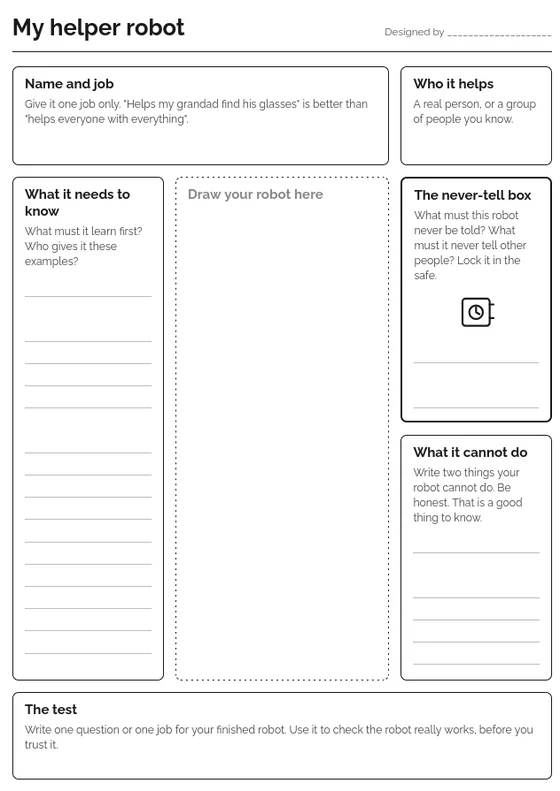
  2. Children fill the design sheet, which has six boxes:

    Name and job. One job only. "Helps my grandad find his glasses" beats "helps everyone with everything".

    Who it helps. A real person or group they know.

    What it needs to know. The examples and information the robot must learn from, and where that comes from. (Push here: "Knows about grandad" is not allowed; which things about grandad, and who gives it those things?)

    The never-tell box. What this robot must never be told, or never pass on. Every robot gets one; a robot that needs no secrets kept is a rare thing.

    What it cannot do. Two honest limits, written proudly, like Pip's warning sticker.

    The test. One question or task you would give the finished robot to check it really works before you trust it.

  3. Share-out, designer's choice of format: a quick stand-up pitch, a gallery walk where designs sit on desks and designers stand by them, or a "robot showroom" where pairs demonstrate by acting the robot out. Whatever the format, the audience may ask one question, and the house favourite is "what does it do when it is not sure?"

  4. Close.

    Say

    "You have just done four real jobs from the AI world: you chose a purpose, you chose the learning examples, you protected someone's private things, and you designed a test. People are paid to do exactly this. Remember that it started with you, a pencil, and someone you care about."

Watch for

Feature creep (the robot that flies, cooks and does homework). The fixing sentence: "Every extra job needs extra knowledge about people. Big appetite for jobs means big appetite for secrets. Small and kind beats big and nosy."

The conversation

  1. What did you put in the never-tell box, and why? Direction: this is data minimisation growing in real time; treasure whatever arrives.
  2. Whose robot would you actually want in your house, and what convinced you? Direction: usually the specific, modest ones. Notice that aloud.
  3. Stretch: your robot guesses like Pip. What happens on the day it guesses wrong about the person it helps? Direction: limits, checking, and asking; the full arc of the pack in one question.
Younger classes (6–8): drawing first, boxes second. Let children draw the robot large, then fill only three boxes (name and job, who it helps, the never-tell safe), with an adult scribing for writers-in-progress. The never-tell box works at any age; keep it.
Older classes (9–11): all six boxes, and push hardest on "what it needs to know" and "the test". Pairs can swap sheets before the share-out and try the other team's test question against the design: the first peer review of their lives, on paper.

The printables

Five sheets, one pair of scissors

The sorting cards come in colour; everything else photocopies cleanly in black and white. Print them from the printables page; card backs stay blank on purpose.

Printable 1 · Activity 2

Spot the Guesser cards & corner signs

12 colourful picture cards: light switch, piano, calculator, automatic shop door, fairy lights, weather forecast, a "what to watch next" screen, car GPS, smart speaker, talking teddy, robot vacuum, a computer-game baddie. Plus three corner signs: FIXED, GUESSER, NEEDS INVESTIGATING.

3 × A4
Printable 2 · Activity 2

Guesser Detectives field sheet

One per group: three columns (Fixed, Guesser, Needs Investigating), a "because…" reason line for each catch, and an Investigation box for the machines they crack and move.

1 × A4
Printable 3 · Activity 3

Job cards & corner signs

16 job cards in large type, plus one blank card (older classes write their own) and three A4 corner signs: ROBOT, HUMAN, BOTH TOGETHER.

5 × A4
Printable 4 · Activity 4

Helper robot design sheet

One A4 sheet: a large drawing space in the centre, the six boxes around it, and the never-tell box drawn as a small safe.

1 × A4
Printable 5 · Activity 2 · optional

Extra Guessers (paper mission)

For the days you cannot roam: twelve more machines from a child's own world (toaster, traffic light, robot dog, a car that brakes by itself…), sorted with the same three signs. The answer key sits inside Activity 2.

2 × A4
Open the print-ready sheets

It looks like stories and games. Here is what it built.

In the language of the EU/OECD AI Literacy Framework (2026), the new official reference for AI literacy in European schools:

  • The Robot in the Box gave them accurate language for how AI works: pattern matching without understanding, confident errors, learning from flawed examples, words followed without meaning (Engage with AI 2). When your child one day says "it sounded sure, but it's just a Pip", the story did its work.
  • Spot the Guesser taught children to recognise AI in daily life (Engage with AI 1) and, better, to say "I would need to find out" when the outside gives no answer. The Guesser Detectives hunt turned that into something they did on their own feet.
  • Robot Job or Human Job? built the deciding habit: is this a task for a machine, a person, or both together (Manage AI 1)? Adults who never learned this hand over too much or refuse too much.
  • Design Your Helper Robot made them designers: one purpose, chosen knowledge, a never-tell box, honest limits, and a test (Shape AI 1 and 3). That never-tell box is the beginning of privacy-by-design thinking, and they drew it as a safe.

The pack also lands the first level of UNESCO's AI competency framework for students (2024), the global reference: human agency (people decide which decisions stay with people), embodied ethics (the never-tell box), AI foundations (pattern machines, examples, guessing) and problem scoping (one purpose, chosen knowledge, a test). UNESCO puts the human-centred mindset first among its four aspects, ahead of anything technical. So does this pack.

No child needed a screen, an account, or a single piece of personal data. That is by design, and it is the standard we would like you to hold every AI product to.

When the pack is done

Two paid packs continue where this one stops, same rules, four further sessions each: Know or Guess? (ages 6–8) and Second Opinions (ages 9–11). Our free guide for parents is on its way, and teachers and parents swap what worked in our free Safe AI community.

Browse the resource library

Maps to the AILit Framework (OECD/European Union, 2026): Engage with AI, Competences 1 and 2; Manage AI, Competence 1; Shape AI, Competences 1 and 3, Basic level. AILitFramework.org. Also aligns with the UNESCO AI competency framework for students (2024), Understand level: human agency, embodied ethics, AI foundations and problem scoping. unesco.org. Free resource from AI Safe Lens, released under CC BY-NC-SA 4.0. Story "The Robot in the Box" © AI Safe Lens 2026, same licence.